

Kurds Divided Across Four States:
State Security Concerns and the Test of Peace in the Middle East
By Cüneyt ALPHAN
When we look at the recent history of the Middle East, we see that the story of the Kurds is about much more than the division of a people. It is also a story of the collapse of empires, the establishment of new nation-states, the drawing of borders, and the regional calculations of major powers.
Throughout this process, while struggling to have a say in their own future, the Kurds have often become subjects of other states’ security concerns, political bargains, and regional rivalries.
The geography inhabited by the Kurds has been at the center of power struggles dating back to the Ottoman-Safavid rivalry.
During the Ottoman period, Kurdish principalities sometimes formed alliances with the central administration and at other times maintained their autonomous structures. However, as centralization policies intensified in the nineteenth century, many of these structures were dismantled.
Thus, the political existence of the Kurds at the local level was shaped not only by their own social dynamics but also by the state mentality and security policies of the era.
The new political order that emerged after the collapse of the empires did not resolve the Kurdish question. Instead, it placed the issue within the borders of four separate states.
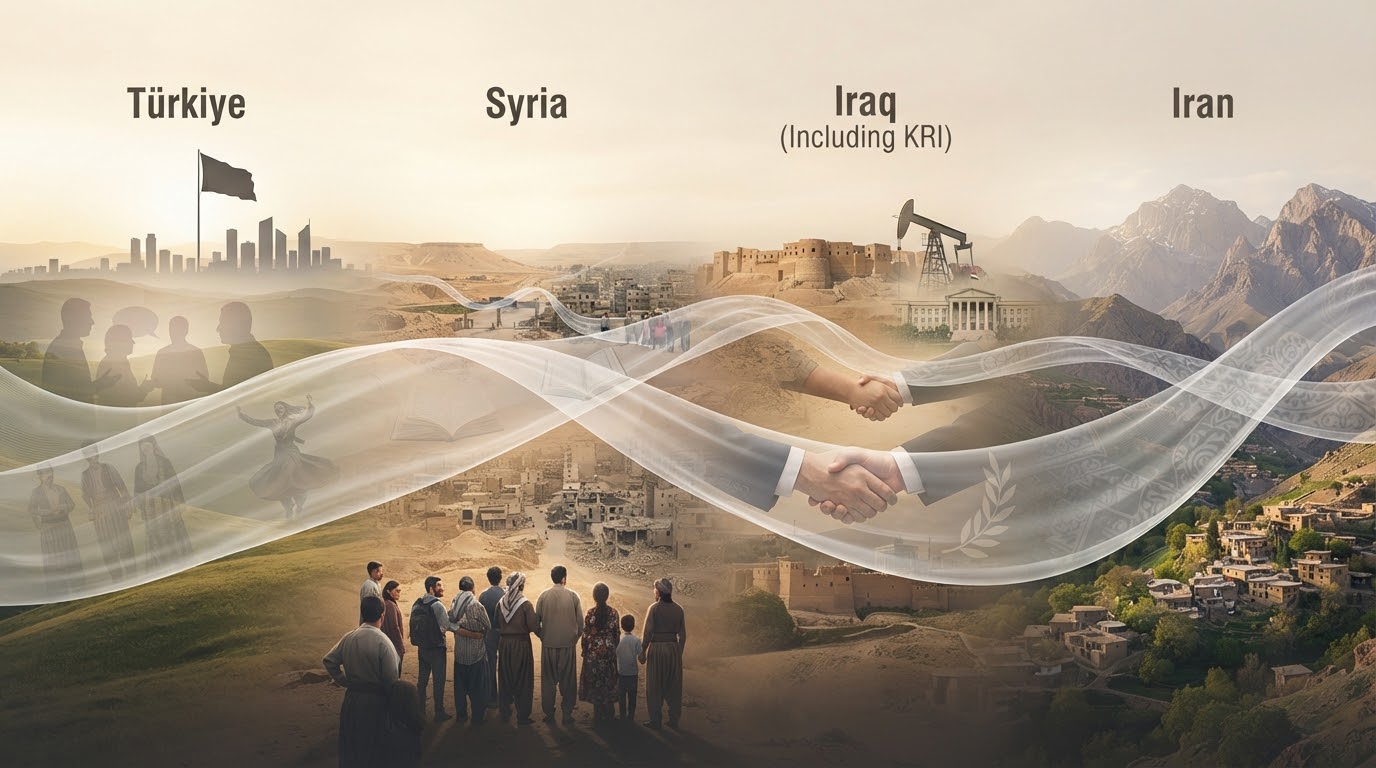
Kurds living in Türkiye, Iran, Iraq, and Syria have faced similar fundamental challenges under different historical and political circumstances: recognition of their identity, the right to preserve and develop their mother tongue, equal citizenship, and the ability to have a say in the future of the regions where they live.
The policies of these four states are, of course, not identical.
Each has its own history, social structure, security doctrine, and political balance.
Yet one common question has persisted:
Why have the political and cultural gains of the Kurds so often been treated by these states as a security issue rather than as a matter of rights and democratic representation?
Political differences, rivalries, and disagreements among the Kurds themselves are also part of this historical picture. However, these differences cannot justify ignoring Kurdish demands for rights or portraying the achievements of one part of Kurdistan as a threat to Kurds living in another.
Four States, Different Policies, One Common Security Question
In Türkiye, the Kurdish question was for many years addressed predominantly through the frameworks of security and counterterrorism.
The democratic discussion of Kurdish identity, language, and demands for political representation often remained overshadowed by this security-oriented approach.
The fact that a new peace process is being discussed in Türkiye today is therefore significant not only in terms of ending armed conflict, but also in terms of confronting past mistakes and developing lasting democratic solutions.
In Iran, Kurdish demands for political and cultural rights continue to face the country's centralized state structure and security policies.
In Iraq, although a federal system was established after 2003 and the Kurdistan Region was recognized in the Iraqi Constitution, disputes between Erbil and Baghdad over oil, the federal budget, border crossings, and disputed territories have continued for years.
In Syria, meanwhile, the power vacuum created by the civil war enabled the Kurds to establish their own administrative structures and security institutions.
Yet these gains have remained under constant pressure because of military confrontations on the ground and the policies of regional powers.
One fact must not be overlooked when assessing this picture:
Kurdish political actors, organizations, and administrations in the countries where Kurds live are not all the same.
Nor are the Kurds a homogeneous community with a single political will, making all decisions from one center. They have significant differences of opinion, political rivalries, and competing visions of the future.
But democratic pluralism requires precisely that such differences be allowed to exist. Political divisions within a people do not make that people's fundamental rights debatable.
Rojava: Security Arguments and the Future of a People
Developments in Syria provide one of the most recent examples of how sensitive this issue has become. The political and administrative structure that emerged under Kurdish leadership in Rojava is not merely a debate over a model of governance.
It is also the product of a search for security, representation, local administration, and coexistence amid war.
Türkiye has conducted military operations, arguing that armed groups in northern Syria pose a threat to its national security.
These security concerns are undoubtedly a real dimension of the regional conflict.
On the other hand, the impact of military operations and clashes on civilians, displacement, and uncertainty about the region's future cannot be ignored.
The security and political representation of Arabs, Syriacs, and other communities living in Rojava, alongside the Kurds, are also integral to this discussion.
The question that must be asked is this:
Will Syria's territorial integrity and Türkiye's security concerns be protected through an approach that entirely excludes Kurdish demands for democratic representation and local self-government?
Or can a political arrangement be established that guarantees the rights of all communities, reduces armed conflict, and makes political reconciliation possible?
Identifying a people's political existence solely with armed organizations risks turning that entire population into part of a security problem.
The policies of armed actors can be criticized and security threats can be debated.
But the rights, identities, and political representation of civilians must remain outside that debate.
Baghdad-Erbil Tensions:
Constitutional Federalism or Centralization?
Developments in Iraq today once again reveal how fragile the gains of the Kurds remain. The Iraqi Constitution recognizes the Kurdistan Region as a federal region.
Nevertheless, disputes between the federal government and the regional administration over the division of powers, the management of oil and natural gas resources, the federal budget, customs, and disputed territories have remained unresolved for years.
On November 24, 2026, Iraqi Prime Minister Ali al-Zaidi issued directives aimed at bringing border crossings administered by the Kurdistan Region under federal authority and expanding federal powers over certain oil fields.
These measures once again heightened tensions between Erbil and Baghdad.
The following day, Iraq's Federal Supreme Court issued a ruling concerning the federal government's authority to secure international borders and oversee institutions at border crossings.
However, the Court's announcement also pointed to the need for coordination with regional administrations in the management of customs and oil and natural gas resources.
The Kurdistan Regional Government, for its part, viewed Baghdad's steps as a violation of its constitutional rights and called for dialogue rather than military threats.
Of course, the Iraqi federal government has constitutional responsibilities regarding the country's international borders, public resources, and the fight against corruption.
The existence of these responsibilities cannot be disputed. But being a federal state does not mean concentrating all powers in the hands of the central government.
Federalism requires the powers guaranteed by the constitution to be exercised through mutual respect, the rule of law, and cooperation.
If Baghdad has allegations of corruption and smuggling, the answer lies in transparent investigations, legal oversight, and joint mechanisms.
Allegations of misconduct in a region should not become a pretext for questioning that region's constitutional status or the rights and achievements of its people.
Likewise, the Erbil administration must fulfill its own responsibilities regarding transparency and accountability when allegations arise within its jurisdiction.
The challenge facing Iraq is neither for Baghdad to establish supremacy over Erbil nor for Erbil to break away from Baghdad.
The real challenge is to make the constitutional federal system function effectively. The law exists not only to protect the powers of the central government, but also to safeguard the rights of regional administrations.
Seeking Peace in Ankara Without Escalating Tensions in Erbil
The peace process underway in Türkiye cannot be viewed solely as an internal Turkish matter.
The regional dimension of the Kurdish question extends from Türkiye's relations with its neighbors to the future of Syria, from Iraq's federal structure to the balance of power across the Middle East.
For this reason, while Ankara pursues peace and democratic solutions at home, it is equally important for Türkiye to adopt a regional approach that respects the constitutional gains of the Kurdistan Region of Iraq.
There is no contradiction between Türkiye respecting Iraq's sovereignty and constitutional order and defending the constitutional rights of the Kurdistan Region.
On the contrary, if Iraq's territorial integrity and federal structure are to be preserved together, the rights of the Kurdistan Region, one of the constitutional partners within that structure, must also be protected.
There is also a noteworthy diplomatic sequence of events.
On October 17, 2026, Iraqi Prime Minister Ali al-Zaidi met Turkish Foreign Minister Hakan Fidan in Baghdad.
Security, trade, water, the Development Road project, and cooperation between the two countries were discussed.
On November 23, Fidan also held a telephone conversation with Kurdistan Region Prime Minister Masrour Barzani.
Baghdad's decisions concerning border crossings and oil fields came after these contacts.
However, there is no verified evidence that these meetings caused the decisions in question or that Türkiye directed them. Nevertheless, these diplomatic contacts raise an important question about the balance and responsibility Ankara should demonstrate in its relations with all parties in the region.
This issue also matters for Türkiye's peace process.
At a time when peace is being discussed in Ankara, narrowing the political gains of Kurds in neighboring countries on security grounds could undermine the credibility of regional peace efforts.
Türkiye should not turn its relations with Baghdad into an instrument of pressure that weakens Erbil's constitutional rights. Instead, it should adopt an approach that brings the parties together on the basis of law and dialogue.
A regional approach that seeks peace in Ankara while escalating tensions in Erbil contradicts the very spirit of peace.
Kurdish Political Differences and the Responsibility for a Common Future
Another dimension of this historical picture is the political divisions among the Kurds themselves.
The struggle of a people divided into four parts, living under different political conditions and organizing through different structures, has inevitably produced different priorities and political approaches over time.
This includes the political rivalry between Barzani and Talabani, the different political structures in Rojava, and internal debates within Kurdish political movements in Türkiye and Iran.
Ignoring these differences would be unrealistic.
However, they must not be allowed to overshadow the Kurds' common demands for rights and freedoms.
Criticizing a Kurdish political leader, supporting another Kurdish political movement, or objecting to the policies of an administration are all natural parts of democratic politics.
But turning political rivalry into hostility between peoples ultimately harms the future of a people that has already been divided.
What the Kurds need is not for everyone to adopt the same political line.
What is needed is for Kurds with different political views to recognize one another's existence and acknowledge the people's shared rights. Gains achieved in one part should not be seen as a threat to Kurds in other parts.
Instead, they should be regarded as an opportunity for democratic rights, equality, and peace.
Barzani can be criticized, Talabani can be criticized, and so can other political leaders.
No leader stands above the people. But political disagreements with any leader can never justify targeting the constitutional and democratic achievements of an entire people.
We must move beyond individual personalities and discuss the issue in terms of the future of the people.
The Responsibility of the International Community
In the policies of international powers, the Kurds have often occupied a contradictory position in the Middle East.
Major powers have cooperated with Kurdish political actors at certain times in line with regional balances and security needs.
When circumstances changed, the limits and priorities of those relationships changed as well.
This demonstrates why the Kurds need to develop a strong political will based on law and democratic legitimacy rather than a political strategy dependent on the support of external powers.
The responsibility of the international community cannot be limited to viewing the Kurds merely as a security partner needed at certain moments.
Protecting constitutional federalism in Iraq, ensuring political representation for all communities in Syria, guaranteeing fundamental rights and freedoms in Iran, and supporting Türkiye's peace process through democratic and legal steps are all parts of the same principled approach.
While the sovereignty and territorial integrity of the countries in which Kurds live are being discussed, the rights of the Kurds living in those countries must be addressed with equal seriousness.
Sovereignty does not grant states immunity from their responsibilities toward their citizens.
Nor can security serve as an unlimited justification for suspending fundamental rights.
Peace Requires Safeguarding Gains, Not Suppressing Them
Today, the Middle East stands on the threshold of a new political era. The restructuring of the state in Syria, debates over federal governance in Iraq, Iran's regional policies, and the renewed search for peace in Türkiye are among the developments that will shape the political landscape of the coming years.
The future of the Kurds must not become a bargaining chip in negotiations between regional states. Like all other peoples of this region, Kurds must be able to exist with their own identities, languages, cultures, and political choices.
This demand does not mean taking rights away from other peoples. On the contrary, it can provide a foundation for equality among all peoples of the region and their determination to live together.
The success of the peace process in Türkiye cannot be measured solely by the silencing of weapons.
Lasting peace requires the rule of law, democratic politics, freedom of expression, equal citizenship, and guarantees of political representation. The same principle applies to Iraq, Syria, and Iran. Discussing peace in one country while restricting political rights in another will make regional problems even more difficult to resolve.
The Kurds, too, must seek ways to overcome their political rivalries and protect their common rights and democratic achievements. External pressure can weaken a people's future, but so can internal divisions and mutual distrust.
History, from the Ottoman period to the present, shows us that the Kurdish question cannot be resolved through security policies alone. Periods of repression, denial, and exclusion have not eliminated the problem; instead, they have created new ruptures across generations. Repeating the same methods in different forms today will not bring peace to the Middle East.
The gains of the Kurds should be seen not as a threat, but as an opportunity to build a democratic Middle East.
My appeal to Baghdad is to respect the federal structure guaranteed by the Iraqi Constitution and the rights of the Kurdistan Region.
My appeal to Ankara is to support the peace process underway in Türkiye through law, dialogue, and mutual respect at the regional level as well.
My appeal to Tehran is to stop treating Kurdish demands for rights as a security threat.
My appeal to Damascus is to build Syria's future on the basis of equal citizenship and political representation for all its peoples.
My appeal to the international community is equally clear:
See the Kurds not merely as an ally to be remembered when needed, but as a people whose rights and political will must be recognized.
Because the future of the Middle East lies not in viewing the existence of other peoples as a threat, but in recognizing one another's rights.
The future of a people divided into four parts cannot be condemned to the security concerns of four states.
Peace is possible not by taking away a people's gains, but by guaranteeing those gains through law and democracy.